Real Lead Flashing vs Lead-Free Alternatives
When a chimney starts leaking into the loft or leaving damp patches on a bedroom chimney breast, the flashing is usually the first thing we inspect. Homeowners often ask us whether they should pay for traditional rolled lead or save a bit of money with modern synthetic flashing tape. Here is an honest breakdown of how both materials perform up on a roof, what they cost, and what to expect when the job is done properly.
Got a damp chimney breast or loose flashing?
Speak directly to our roofing team for honest advice and a free roof inspection.
The Short Answer: Which Should You Choose?
Proper rolled lead sheet is heavy, malleable, and lasts 50 to 70+ years when fitted in the right thickness and length. Because of its dead weight, it sits tightly against roof tiles and won't lift in winter gales.
- ✓ Outlasts most roof tiles and slates
- ✓ Can be dressed and bossed cleanly around awkward brick corners
- ! Higher material cost and requires proper leadworking skill
Made from aluminium mesh, EPDM rubber, or modified silicone with a sticky butyl backing. Good quality versions last 15 to 25 years, whereas cheap DIY store flashing tapes often fail within 5 years.
- ✓ Zero scrap value (ideal if your roof is prone to lead theft)
- ✓ Lighter and quicker to dress over deep-profile concrete tiles
- ! Relies on adhesive to stay stuck down; shorter lifespan than real lead
Understanding Real Rolled Lead: Codes 3, 4, and 5 Explained
If you get three quotes for chimney leadwork, make sure every roofer specifies the lead code they plan to use. Real rolled lead sheet is graded by thickness using codes from 3 to 8. The thicker the lead, the heavier it is, and the better it handles thermal expansion and exposure to the weather.
If a contractor cuts corners and uses thin lead where thicker sheet is needed, the sun will heat the metal, cause it to expand, and within a few summers it will ripple and split down the middle. Around a typical domestic chimney stack, we use three main grades:
| Lead Code | Colour Sticker | Thickness | Where It Should Be Used on a Chimney |
|---|---|---|---|
| Code 3 | Green | 1.32 mm | Soakers only — the hidden L-shaped pieces that sit underneath slates or flat plain tiles. Too thin for exposed cover flashing. |
| Code 4 | Blue | 1.80 mm | Stepped flashings & front aprons — the standard grade chased into the mortar joints down the sides and across the front of the stack. |
| Code 5 | Red | 2.24 mm | Chimney back gutters & saddles — the flat tray behind the chimney where rainwater and snow sit and funnel round the stack. |
We also keep individual pieces of Code 4 lead to a maximum length of 1.5 metres with proper overlaps. Why? Because one long continuous strip of lead cannot expand and contract freely without pulling its mortar joints apart or cracking.
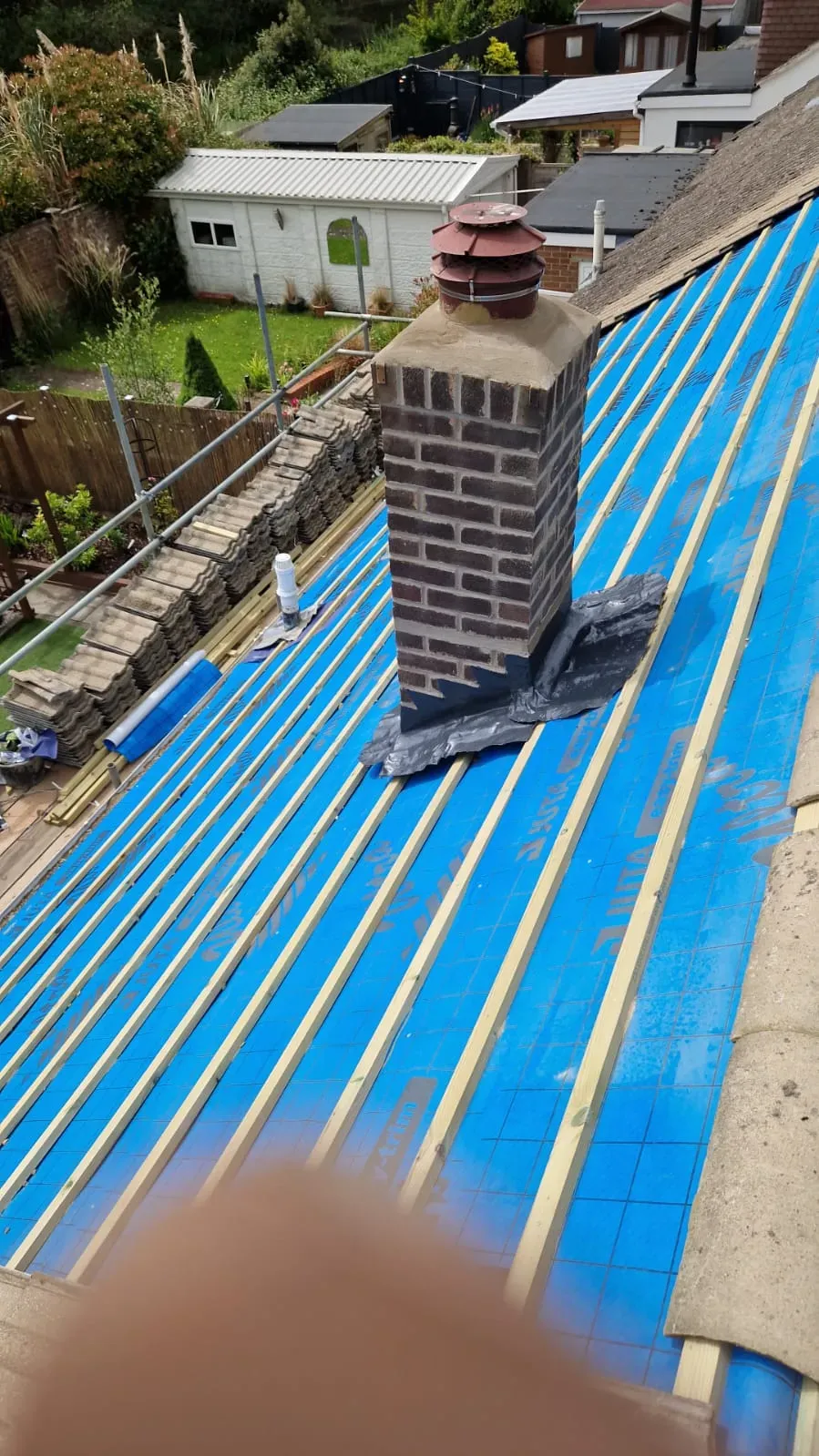
Built Into the Roof Structure
Here you can see new lead flashing fitted cleanly around a brick chimney stack during a roof overhaul. Notice how the stepped sides and front apron are dressed tightly over the battens and underlay before the final tiles go on.
View our Chimney Repairs & Leadwork service →What Are Lead-Free Flashing Alternatives (And Are They Any Good?)
It helps to separate proper trade-grade lead-free flashings from DIY bitumen repair tape. What you buy on a roll in a local DIY shed ("flashband") is just foil-backed tar. It dries out in the sun, peels off dusty brickwork, and should never be used on a house roof.
Trade-grade lead alternatives — such as Wakaflex, Ubiflex, or Dektite Perform — are engineered polymers or EPDM rubber reinforced with an expanded aluminium mesh inside. When you dress them over curved interlocking tiles, the mesh holds the shape.
Where Lead-Free Flashing Makes Sense
- Low-level extensions and garages: If you have a ground-floor lean-to roof next to a public footpath where thieves could easily climb up and strip real lead overnight, synthetic flashing removes the temptation completely.
- Non-toxic rainwater harvesting: If you collect rainwater from the roof for livestock or wildlife ponds, lead-free polymers prevent any metal run-off.
- Deep-profile continental tiles: Heavy concrete tiles with deep rolls can be awkward to dress stiff lead into without thinning the metal; flexible mesh-backed flashing moulds into deep troughs easily.
Where Synthetic Tape Falls Short
Unlike real lead, which stays down because it is heavy, synthetic flashing relies on a butyl adhesive strip underneath to stop the wind flipping the bottom edge up. If the roof tiles have any dust, moss spores, or moisture on them when the tape is pressed down, the sticky backing eventually lets go. And even when fitted to bone-dry tiles on a warm day, it will still need replacing in 15 to 25 years—whereas real lead will outlive the roof.
How Stepped and Apron Flashings Are Chased Into Brickwork
Whether you choose rolled lead or a synthetic system, the top edge of the flashing must be tucked inside the horizontal mortar joints of the chimney stack—never just stuck flat against the face of the bricks with silicone.
Raking Out the Chase
We grind or chisel out the horizontal mortar beds to a minimum depth of 25mm. Down the sloping sides of the chimney, this is done in steps (stepped flashing) following the pitch of the roof.
Fixing with Lead Wedges
The folded top edge of the apron or step is pushed into the slot and locked firmly in place by hammering rolled lead wedges (or stainless steel clips) into the joint. Mortar alone does not hold lead in place; the wedges do.
Pointing or Lead Sealant
After brushing out all brick dust, the joint is sealed with either a breathable mortar mix (lime mortar on older solid-brick chimneys) or a specialist neutral-cure lead mate sealant that moves with the metal.
A quick note on shared chimneys: If your chimney stack sits straddling the boundary line between you and your neighbour on a semi-detached or terraced house, it counts as a party structure. Routine repointing and replacing like-for-like flashing rarely causes an issue, but if the stack needs partial rebuilding, it is always sensible to chat with your neighbour first and check whether the Party Wall Act applies.
Why White Streaks Appear Below New Lead (And How Patination Oil Stops It)
Have you ever walked past a house with brand-new leadwork and noticed ugly chalky white runs staining the dark roof tiles underneath the chimney? That happens when a roofer skips the final step: patination oil.
When newly rolled lead is exposed to rain and morning dew for the first time, it reacts with carbon dioxide in the air to form basic lead carbonate before its stable grey oxide layer has properly developed. Every time it rains, that loose white powder washes down onto your slates or concrete tiles and bonds to the surface.
To stop this happening, we wipe a single, even coat of patination oil across both sides of the new lead (including tucked-under edges) at the end of the day before any rain hits it. It gives the metal an instant, smart matte-grey finish and keeps your roof tiles completely clean while the natural patina forms over the following months.
What to Expect When We Replace Your Chimney Flashing
Replacing the lead around a single chimney stack typically takes 1 to 2 days once safe access is up. Because you cannot safely lean off a ladder with an angle grinder, lead bossing tools, and heavy rolls of Code 4 lead, almost all chimney leadwork requires a small scaffold tower or chimney saddle scaffold with proper edge protection.
- 1. Strip & Inspect: We lift the surrounding roof tiles or slates around the stack, remove the perished flashing, and check the timber battens and felt underneath for rot caused by the old leak.
- 2. Soakers & Back Gutter: We fit a new Code 5 back gutter behind the chimney, lay new Code 3 soakers with every course of tiles or slates, and dress the front apron neatly over the lower course.
- 3. Stepped Flashing & Clean-Up: We chase in and wedge the Code 4 stepped flashing, point the joints, coat the lead with patination oil, and clear every scrap of old mortar from your gutters and driveway.
Our NFRC and City & Guilds qualified roofers handle everything from minor lead re-wedging to full chimney re-leading across Reading, Coley, Oxfordshire, and the surrounding areas, backed by our 10-year workmanship guarantee.
Related Services & Guides
Explore our specialist chimney repair services or read more straightforward advice from our roofing team.
Chimney Repairs And Leadwork in Reading
Expert chimney repairs and leadwork in Reading. Over 25 years' experience. NFRC members. Get a free quote for flashing and repointing. Call 0118 230 3346.
Do You Need Building Regs for a New Roof?
Find out when UK Building Regulations apply to a new roof, including the 25% rule, Part L insulation upgrades, and how NFRC roofers self-certify your work.
What to Do When Your Roof Leaks in Heavy Rain
Discover safe, practical steps to contain a sudden roof leak during heavy rain, protect your electrics, and get your home ready for an emergency roofer.
Wooden Fascias: Cap Over or Full Replacement?
Should you cap over old wooden fascias with uPVC or pay for a full replacement? Learn why capping over rotting timber can damage your roof rafters.
How Long Does an EPDM Rubber Roof Last?
Find out why a seamless, single-sheet EPDM rubber roof easily lasts 40 to 50 years with hardly any maintenance compared to traditional torch-on felt.
Do You Need a Roof Survey Before Buying a House?
Standard RICS surveys often only check roofs with binoculars. Learn how a proper roofer's inspection spots hidden rot and helps you renegotiate the price.
Dry Ridge and Verge Systems vs Mortar Bedding
Compare dry-fix ridge and verge systems with traditional mortar bedding. Learn about BS 8612 standards, loft ventilation, and stopping wind uplift.
Commercial Valley Gutter Cleaning and Lining
Learn why blocked or rusted valley gutters cause warehouse floods, and how planned silt clearance and seamless linings stop leaks.
Why Do Some Fibreglass Roofs Crack or Pinhole?
Find out why cheap GRP flat roofs blister or crack. Learn how dry OSB3 decking, expansion joints and proper resin mixing ensure a watertight finish.
Open-Cell vs Closed-Cell Spray Foam Removal
Learn the difference between soft open-cell and rigid closed-cell spray foam, and how we remove both safely without damaging your roof timbers.
Why Pressure Washing Roof Tiles Causes Leaks
Learn why jet washing roof tiles strips their protective surface, cracks mortar, and floods your loft, plus how manual scraping safely clears moss.
Roofing Scams and Doorstep Traders to Avoid
Learn how to spot common UK doorstep roofing scams. Check our homeowner guide on 14-day cooling-off periods, NFRC accreditation, and itemised quotes.
Why Chimney Back Gutters and Secret Valleys Leak
Find out why hidden chimney back gutters and secret valleys cause ceiling damp patches, even when your roof tiles look completely intact.
Need Your Chimney Flashing Inspected or Replaced?
Whether you have a small leak after heavy rain or need full Code 4 and Code 5 leadwork dressed around a chimney stack, we provide clear photos from the roof and honest, fixed-price quotes with no pushy sales talk.